MIST

Multi-stage Transcranial Artifact Suppression Network for
Brain Ultrasound Localization Microscopy

Jihyeok Jung1, Hyungmin Lee1, Haedong Jeong2*, Sua Bae*1
1Department of Electronic Engineering, Sogang University
2Department of Art and Technology, Sogang University

Abstract

Background & Limitation: Ultrasound signals become blurred and distorted as they pass through the skull, making it difficult to clearly visualize cerebral vasculature. A major bottleneck is the absence of ground-truth open-skull and transcranial observation pairs.

Our Goal: To overcome this, we generate structure-preserving pseudo pairs and train a model to restore transcranial images to open-skull quality.

MIST: We propose a multi-stage network. First, CycleGAN with Localization Loss generates synthetic paired data. Second, a Uformer model restores these images, performing denoising, resolution enhancement, and PSF restoration.

Methodology

1. Pseudo-Pair Generation

We utilize CycleGAN with a novel Localization Loss to convert open-skull images into transcranial-style images while preserving microbubble dynamics.

2. Transcranial Restoration

A Uformer-based supervised model learns to reverse the degradation (Open-skull ↔ Synthetic Transcranial) to remove skull-induced artifacts.
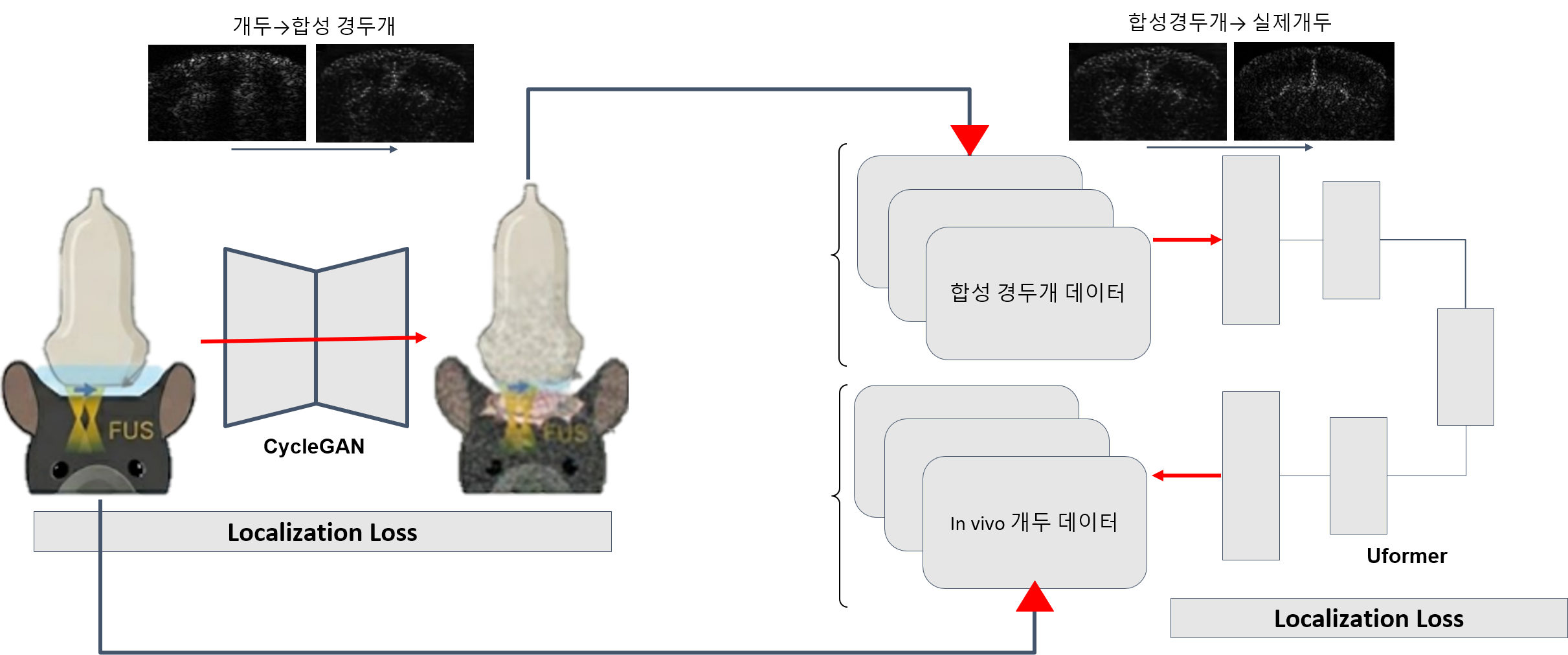
MIST Pipeline Diagram
Figure 1: The MIST Pipeline. Stage 1 generates pseudo-pairs, and Stage 2 restores the image.

Example Images

Real Open-Skull Image
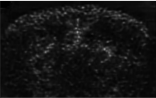
Synthetic Transcranial Image

Simulation Videos

Open-skull Simulation
Transcranial Simulation

Results

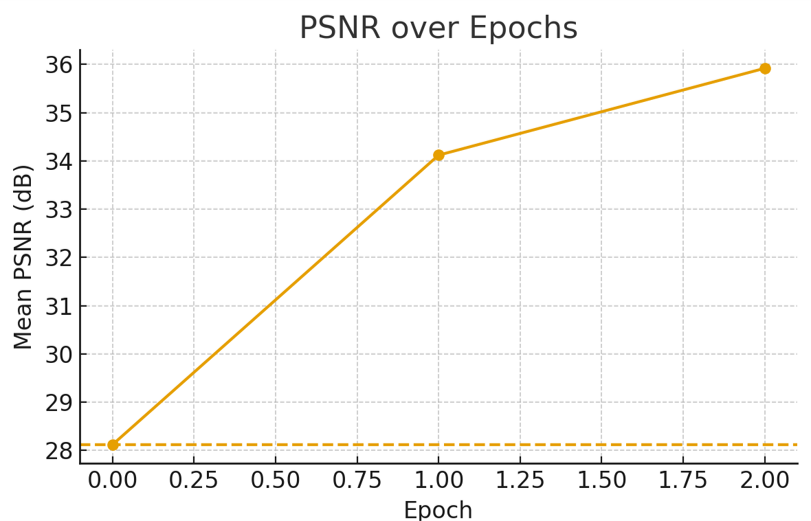
Quantitative: MIST achieves significantly higher PSNR compared to baselines (Richardson-Lucy, CycleGAN-only), improving by 7-8 dB.
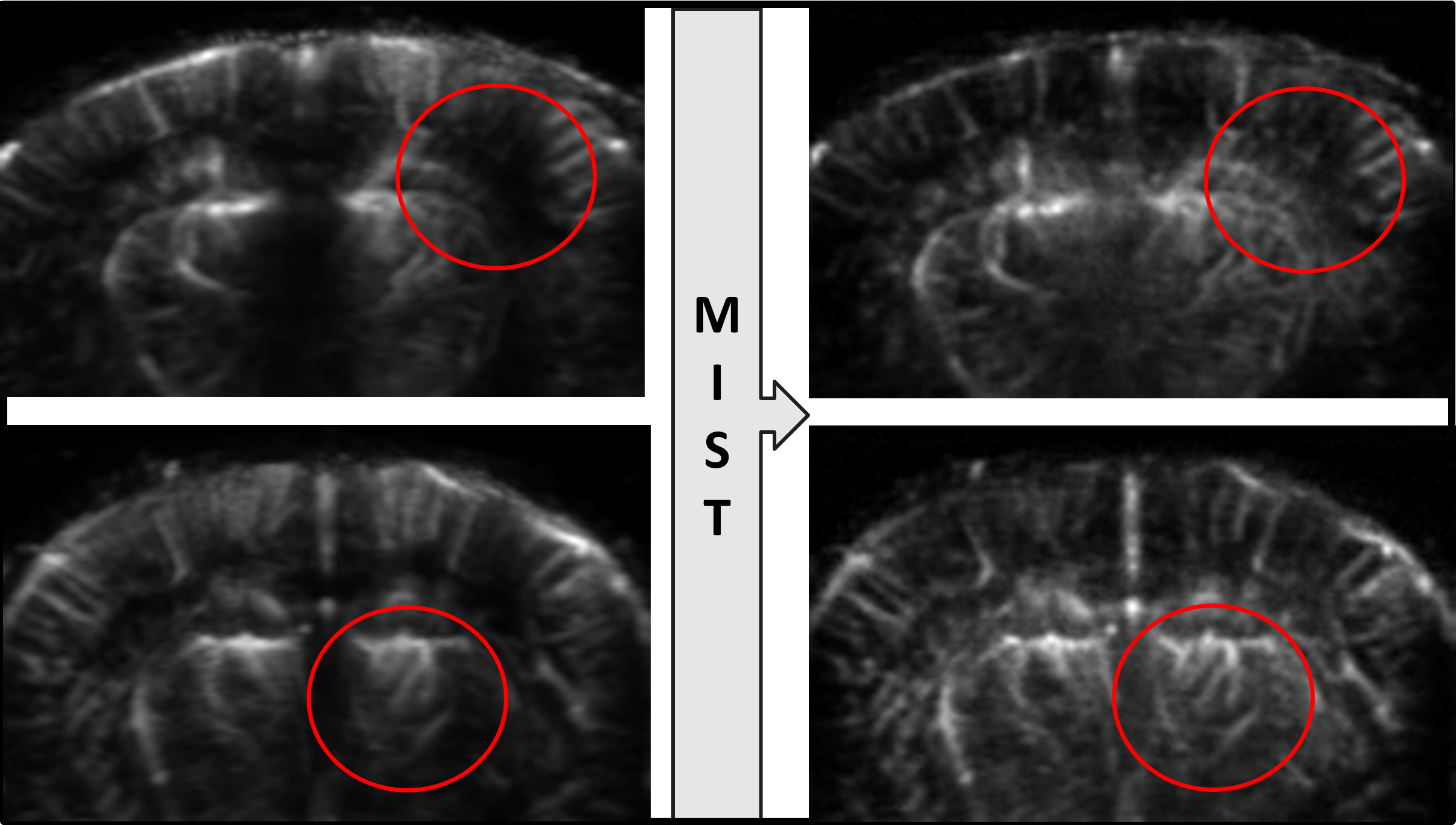
Qualitative: Restores faint vessels and sharpens the image, effectively overcoming skull-induced blur.

PSNR Comparison
PSNR Improvement
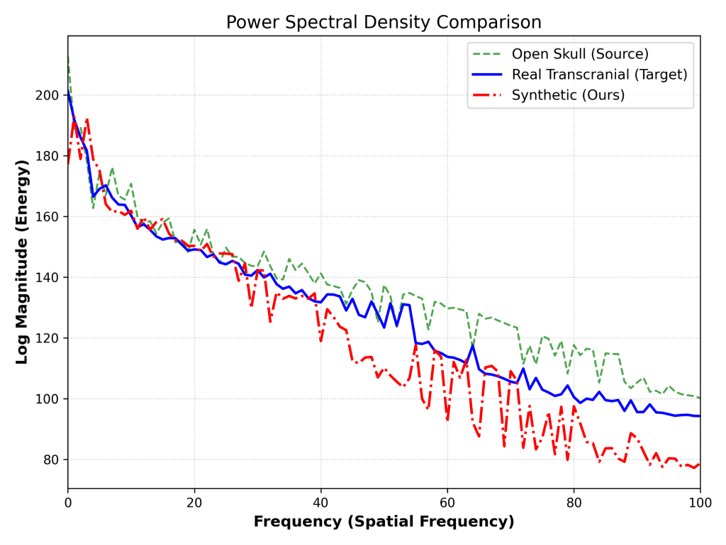
Metric Plot
Metric Comparison
Visual Results
Visual Comparison: Transcranial vs. MIST Restoration vs. Ground Truth

Conclusion

MIST restores severely degraded transcranial ultrasound into clear cerebrovascular images without invasive craniotomy. It delivers vascular enhancement and significant PSNR gains. Future work will expand evaluations to verify physical fidelity.

References

  1. Wang, Z., et al. "Uformer: A general u-shaped transformer for image restoration." CVPR 2022.
  2. Zhu, J.-Y., et al. "Unpaired image-to-image translation using cycle-consistent adversarial networks." ICCV 2017.
  3. Blanken, N., et al. "PROTEUS: A physically realistic contrast-enhanced ultrasound simulator..." IEEE TUFFC, 2024.
  4. Errico, C., et al. "Ultrafast ultrasound localization microscopy..." Nature, 2015.

Contact

Jihyeok Jung

Jihyeok Jung is an undergraduate researcher in Electronic Engineering at Sogang University. His primary research focuses on Multimodal and Vision-Language Models, leading to a first-author paper at CVPR 2025 on egocentric instruction tuning. His research interests also actively extend to the medical domain, particularly deep learning for ultrasound imaging.


Hyungmin Lee

Hyungmin Lee is a researcher at the Sogang MIST Laboratory, specializing in developing algorithms for transcranial ultrasound restoration. His work emphasizes artifact suppression and image quality enhancement in challenging scenarios.

Organization

Sogang University Logo
MIST Lab Logo